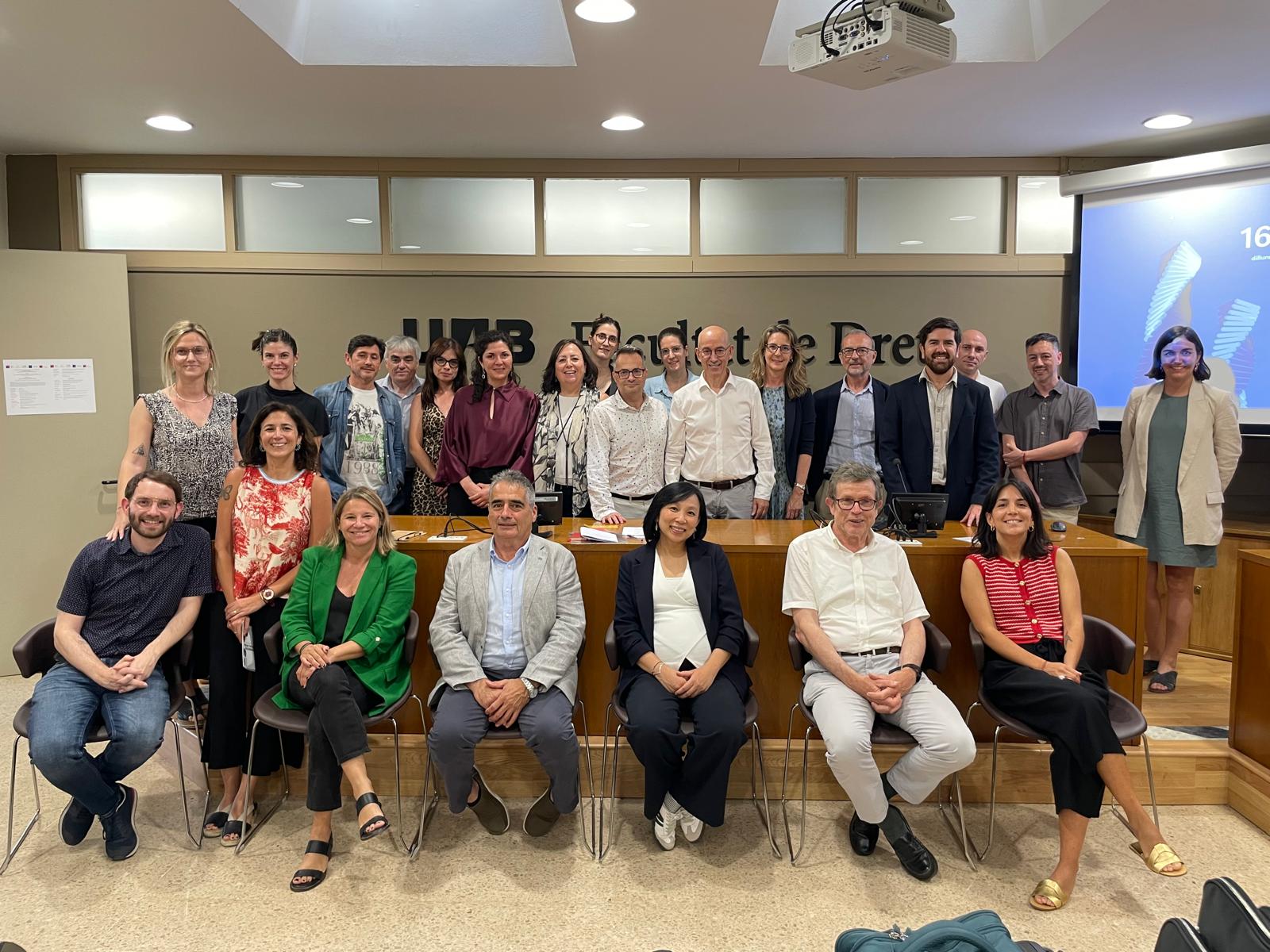
- For the second consecutive year, it is being held Chile – Spain Meeting on Crime and Criminal Justice, in the Faculty of Law, Autonomous University of Barcelona, an event that brought together researchers and experts in the field.
This international meeting brought together academics, institutional actors, and civil society from Chile and Spain to reflect on key issues such as immigration and crime, organized crime, and sexual violence.
The event was inaugurated by the dean of the Faculty of Law of the Autonomous University of Barcelona, Susana Navas.
The first panel addressed immigration, crime, and criminal justice, featuring Elisa García, Professor of Criminology at the University of Málaga; Romina Ramos, academic at the University of Tarapacá and alternate director of the Criminal Complexity Millennium Nucleus, and Carmen Navarro, full professor of Procedural Law at the Autonomous University of Barcelona.
At the event, Romina Ramos, an academic at the University of Tarapacá and alternate director of the Millennium Nucleus on Criminal Complexity, stated that “there are common trends globally, where the most relevant elements in the field of criminality, both in Chile and in Spain, are expressions of violence, sexual crimes—which have been on the rise—and cybercrime. These three factors combine in expressions of criminality, such as, for example, that associated with human trafficking, which is the case I investigate. We also share elements regarding the behavior of the penal system, in which we still need to advance in terms of recognizing gender-related crimes. We also discussed the myth of the link between migration and crime.”.
Then, the second panel on organized crime, presented Andrea Giménez-Salinas, professor at the Pontifical University of Comillas and president of the FIADYS Foundation; Pablo Carvacho, director of research and development at the UC Center for Justice and Society Studies (CJS) and principal researcher at the Criminal Complexity Millennium Nucleus; and Sergio Faúndez, PhD student in Criminology at Pompeu Fabra University.
Next, the prevention and state response to sexual crime was discussed, with the participation of Thuy Nguyen, professor at the International University of Catalonia; Francisca González, coordinator of the Childhood Area of the UC Center for Studies on Justice and Society; Paloma del Villar, director of the Childhood Observatory of the Colunga Foundation (Chile) and Elvira Vergara, Ph.D. student at Pompeu Fabra University. “Together with Paloma del Villar, ”We are presenting the data from the report against violence and also regarding the consultation with children and adolescents (NNA), in the context of the videotaped interview law," stated Francisca González, coordinator of the CJS Children's Area.
The day concluded with a panel discussion on Crime and Punishment in Chile and Spain in the 21st Century, with the participation of Catalina Droppelmann., executive director of the UC Center for Justice and Society and director of the Criminal Complexity Millennium Nucleus; Osvaldo Vásquez, project coordinator, Corporación Opción Chile; Daniel Varona, Professor of Criminal Law and Criminology, University of Girona; Carles Soler, Directorate-General for Penitentiary Services, Government of Catalonia; Francesc Guillén, president of the Catalan Association for the Prevention of Insecurity through Environmental Design (ACPIDA); and Josep Cid, professor of Criminal Law and Criminology, Autonomous University of Barcelona.
In this regard, Catalina Droppelmann, executive director of the UC Center for Justice and Society Studies, emphasized that “each country presented its research and there was a debate around the similarities and differences in the findings, and a closing panel was held where we discussed the most relevant issues and the greatest challenges regarding new forms of criminal complexity in Chile and Spain. We were able to identify good practices and also challenges from the standpoint of research, and the importance of generating good data, as well as implementing effective practices in the penal and penitentiary systems of both countries, was highlighted.”.
Among the projections for the next edition of the meeting—which will be held next year—it was proposed to address the issue of pretrial detention. The need was raised to analyze its growing use in Chile, where the proportion of people in pretrial detention has risen from 25% to 40% of the prison population. In contrast, Spain reduced that proportion from 40% to less than 15%.
The activity was organized by the Center for Justice and Society UC, the SGR in Criminal Justice and Penology (University of Girona – Autonomous University of Barcelona) and the Criminal Complexity Millennium Nucleus, a project funded by the National Agency for Research and Development (ANID). Furthermore, it had the support of the Embassy of Chile in Spain.