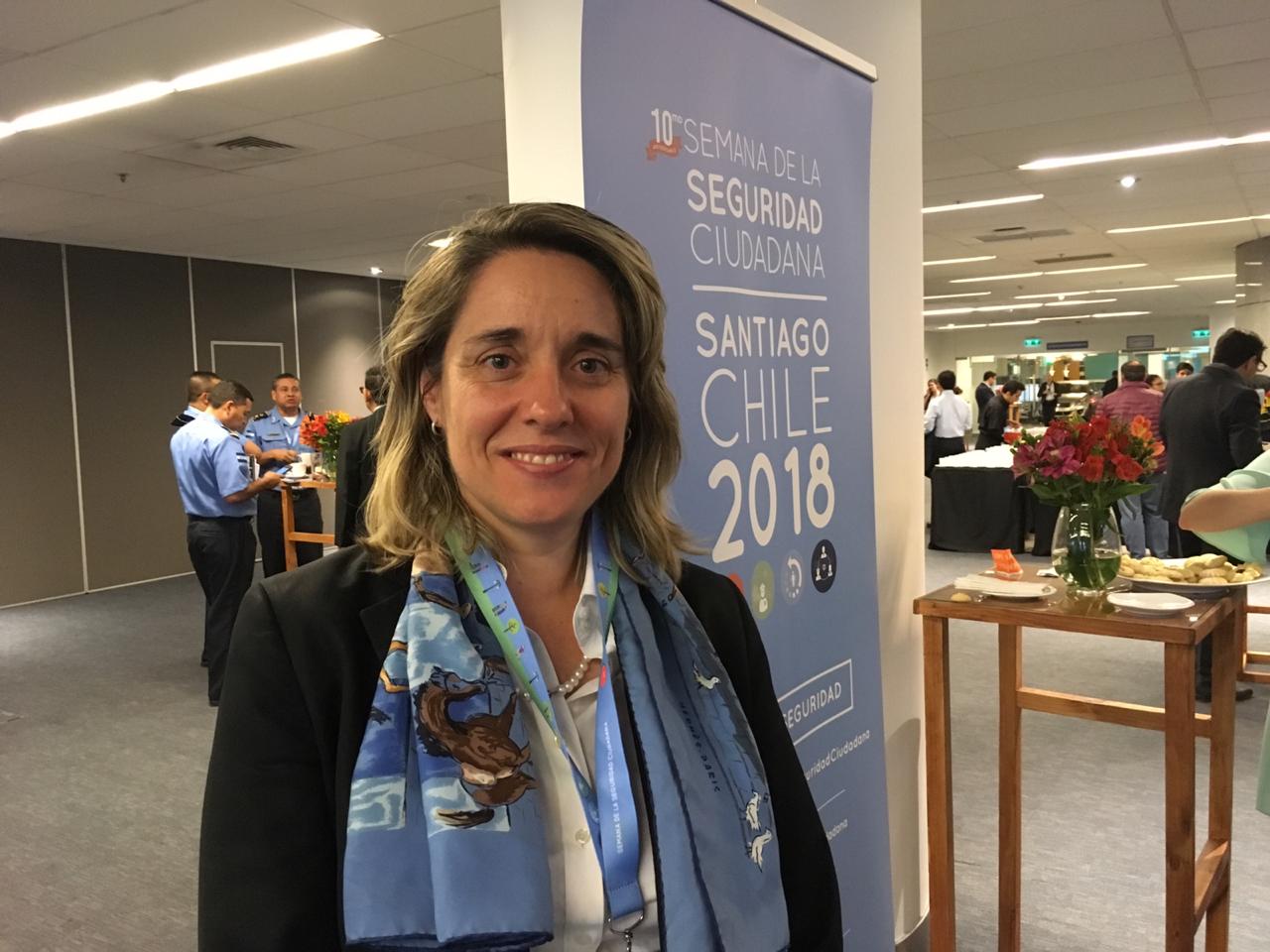
The model of deprivation of liberty that educates and focuses on reintegration
March 5. Costa Rica implemented an innovative model that looks out for the human rights of “residents” in the prison system. IDB expert Beatriz Abizanda explains the details.

By Ignacio Echeverría
For inmates deprived of their liberty to have academic leveling classes, job training, and psychological help is a chimera for the Chilean reality, but it is already a reality in one Latin American country. This is Costa Rica, where the integral units model, focused on the reintegration of these individuals into society, has been applied for a few years now.
Beatriz Abizanda, senior specialist in State modernization for the Inter-American Development Bank (IDB) in this country, told the Justice and Society Center of the Pontifical Catholic University of Chile about the details of how this idea was developed, which allowed Costa Rica to innovate in its prison operations.
“Costa Rica was the victim of an equation that I would call perverse, in the sense that starting in the mid-2000s crime began to rise, but fortunately or unfortunately—because everything has two sides—the police began to be more proactive and more effective in criminal detection, he explained.
Furthermore, “the judicial system was equipped with courts called flagrante delicto courts, which through an expedited procedure were faster in rendering sentences, mostly convictions, and this led to an almost exponential increase in the number of people entering the penitentiary system.”.
Another thing that changed the Costa Rican reality at that time is that “there was a legislative change with tougher penalties, meaning that minor antisocial behavior problems that previously were not considered crimes, but rather misdemeanors, became crimes, so we had a sort of perfect storm due to better state action accompanied by an increasing crime problem.”.
How was the penitentiary system able to resist those changes?
- It was collapsing. Costa Rica, which used to not have an overcrowded prison system, starting in 2008 saw increases at annual rates of 30, 40, and 50% in the number of people entering with longer sentences. Furthermore, it fell victim to a major fiscal problem which meant that the prison system—which is generally not a top priority for countries because there are always social, educational, and other issues—fell somewhat short of the investment it needed.
What about the overcrowding?
- At the time of implementation, the system was under pressure from overcrowding, but there was also a very strong awareness that the prison system should not merely be for processing people, but that the prison system should have a function of support and preparation for release in order to try to mitigate the circumstances that pushed people into a life of crime, so that at least they can be given a platform and helped to make different decisions once they leave. And this is the model of comprehensive care units.
Comprehensive Care Units
In that context, in 2008 Costa Rica sought international help, initiating talks with the Inter-American Development Bank in search of financial support “but also technical support and to bring the best experiences of what a good penitentiary system is to the country.”.
Later, in 2011, the loan was approved and its implementation began around 2014. “That is when the designs are contracted, which for the first time were not designs made by the prison system, but were designs made with the prison system. A firm came in and over a period of eight months with about 16 workshops it was possible to reach the concept and design of what could be the Comprehensive Care Units,” says Beatriz Abizanda.
The important thing about it is that the design involved all units and departments of the Costa Rican penitentiary system (psychology, medicine, counseling, education, maintenance, prison police, agro-industrial production, legal support, statistics, etc.), which is why it was a collaborative effort that ultimately allowed for its implementation.
And what exactly are these units, and what role do they play in the system?
- Inmates enter the comprehensive care units in the final months of their sentence. Once they enter them, they are referred to as ‘residents’.
Why only in the latest stages?
- We know that the final stages are critical to ensure a better reentry.
And what is the difference? What do they do during those months?
- What we want is to support them with academic leveling, since 70% of those in the Costa Rican penitentiary system and perhaps in the region have not finished high school, to also support them with professional training, but above all to work with them on their socio-emotional capacities and skills; and mental health problems, which are unfortunately all too frequent in the prison environment.
How many people are successfully assisted in the process?
- They have space for 1,600 deprived-of-liberty persons and, in early results, because we have barely been operating for a year, by the end of 2017 they were at full occupancy. The first releases have not yet occurred.
And how has this change been for the inmates?
- I can tell you that 80% of the inmates there feel that the rules of the game are clear, they feel that there is respect and legitimacy in how they and their families are treated, and what empirical evidence in other countries, primarily England, has taught us is that this is associated with positive effects in terms of reintegration. It is a combination of treatment and care, treatment and attention, which are two sides of the coin of social reintegration and are critical to ensuring better outcomes when these individuals are released.
Work turns out to be just one part of this social rehabilitation…
- This is a very vernacular way of understanding discharge preparation that is typical of Costa Rica, and it is somewhat derived from a model they have there called Productive Units, where the rehabilitation focus was thought of solely as work as a tool for reintegration. However, what international evidence has shown us is that work per se does not help with reintegration—of course it is an element, but there are other elements such as academic preparation or work at the socio-emotional level, and this triad is what truly yields better results. One cannot be done without the other.
Replicate the model
Beatriz Abizanda was in Chile as part of Citizen Security Week. She says that the Latin American reality is complicated, but that our country has advanced thanks to professionalism and adequate resources that allow it to be above the average on these issues. However, the Comprehensive Care Units model does not exist in our country.
“It’s no secret that the situation in the region is very difficult. We’re talking about an average overcrowding rate of 68%. We’re seeing a very high prevalence of pretrial detention for very long periods. ”What I hope is that events like this will facilitate an exchange of experiences, because every country serves as a sort of small-scale laboratory; the problem is that evaluations are often infrequent and these systems continue to operate on a very small scale,” he explained.
Could Costa Rica's Integral Units be replicated?
- There is a great regional awareness, something that did not exist before, and I believe we have a good starting point to innovate and continue applying this. But it is very important that these are decisions made within the countries, in accordance with their legal framework and also their institutional culture. What has worked for Costa Rica might not work somewhere else.
But there may be certain foundations, minimum bases for that change...
- Yes. The importance of forming alliances with the academic entities of the region, the importance of having a more fluid, freer dialogue between the parties seems fundamental for these promising experiences to be evaluated, and if they work well, to advance to the next level.
And in the case of Chile?
- I feel that in Chile there is a strong academic community, very specialized in this subject; I don't know much about the Chilean penitentiary system, but they have been innovative in many things, for example, in the privatization of prison facilities. I believe that Chile is in a privileged position to do this, because they have the resources and the right professionals to execute this type of reforms, but it has to be something that arises from the Chilean system; imposition from the outside has no institutional footing and the important thing is that Chilean experiences can be recognized, adapted, and Chile finds its own way to address the problem.