- The UC School of Government professor and researcher at the Millennium Nucleus for Criminality Complexity (NMCC) presented before the Chamber of Deputies' Public Security Committee, where he warned that the initiative lacks evidence to support its effectiveness and presents risks to social reintegration and fundamental rights.
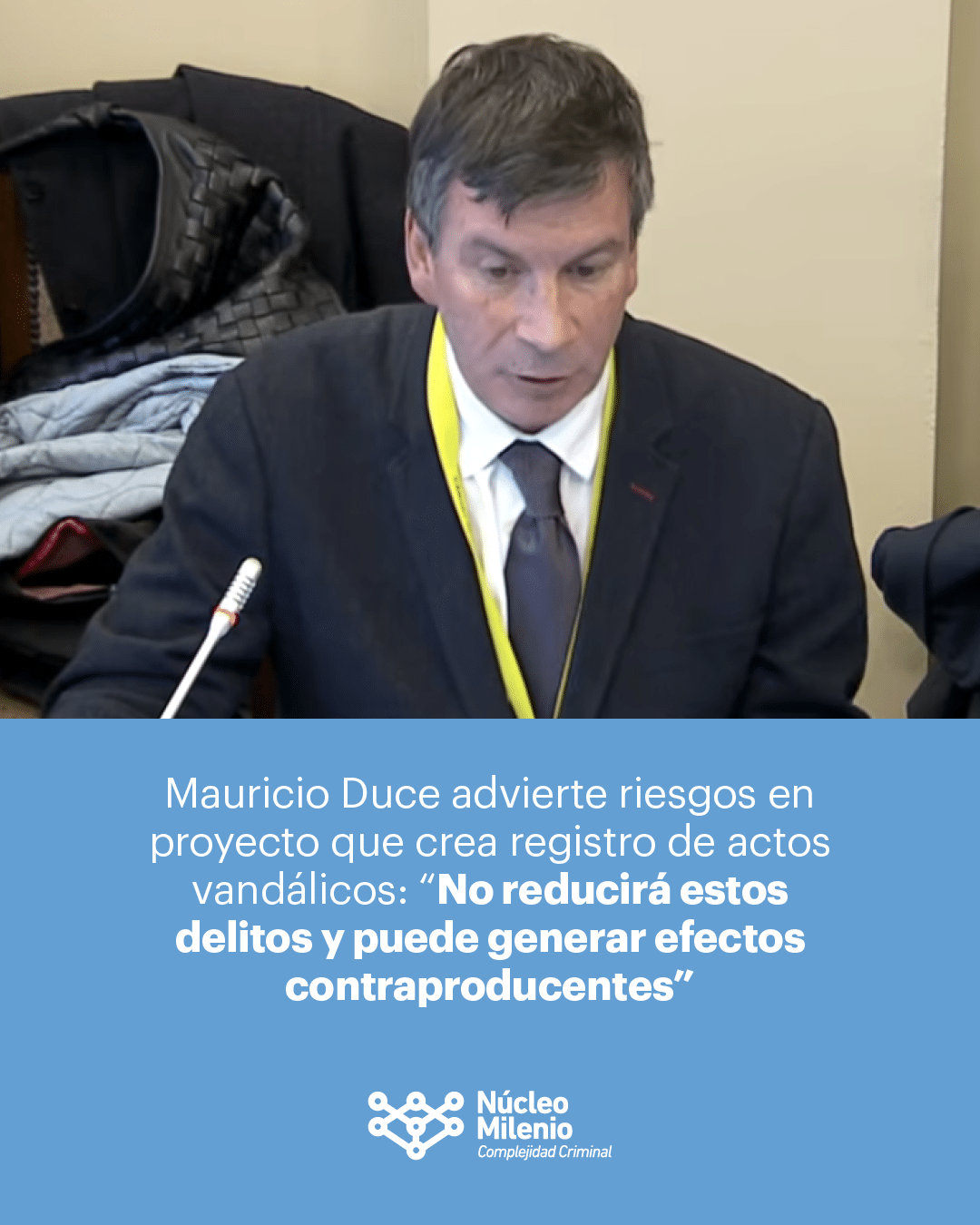
Mauricio Duce, an academic at the UC School of Government and researcher at the Millennium Nucleus for Criminal Complexity (NMCC), along with the executive director of the Paz Ciudadana Foundation, Daniel Johnson, and Emilia García Cox, director of studies at Ideapaís, presented before the Chamber of Deputies' Public Security Commission regarding the bill that creates a National Register of Vandalism Acts and Incivilities (Bill No. 18.341-25).
During his presentation, Duce argued that this initiative “will not reduce these crimes and may generate counterproductive effects.» In addition, he added that the bill stems from a flawed diagnosis by assuming that the problem lies in a lack of sanctions. He explained that most of the behaviors included in the initiative already have criminal or administrative sanctions, in many cases even the highest penalties in our penal system, and that criminological evidence shows that increasing penalties, on its own, does not have a relevant deterrent effect.
«The available research indicates that deterrence depends primarily on increasing the probability of detection and effective punishment, rather than on making penalties harsher,» Duce pointed out, citing international studies on crime prevention.
One of the aspects that was most questioned was the creation of a public registry of sanctioned individuals, accompanied by restrictions on accessing certain social and educational benefits. As he explained, available evidence on similar mechanisms is scarce and does not show that they reduce recidivism or crime. On the contrary, various studies show that they can generate processes of stigmatization and social exclusion, especially when dealing with young people.
It also identified various problems in the proposal regarding the respect of fundamental rights. They include the direct contradiction that exists between the penalty of forfeiture of the Universal Guaranteed Pension and explicit constitutional norms that prohibit it. In addition, it identified general constitutionality problems in the regime of measures or sanctions that the registry would impose with the guarantees prohibiting double jeopardy for the same act (double jeopardy), the principle of proportionality of sentences, due process, and equality.
Alternatively, Duce proposed reviewing the classification and penalties established for certain acts that could be categorized as incivilities; strengthening the effective enforcement of existing penalties (especially fines); and moving toward an evidence-based crime prevention and prosecution strategy. Among his proposals, he emphasized that reviewing penalties presents an opportunity to expand the use of measures such as reparation of harm and community service, and to introduce restorative mechanisms, especially in the case of young people. He also stressed the need to design differentiated responses for the criminal prosecution of incivilities, distinguishing according to the type of offense and prioritizing strategies that have proven to be more effective in crime prevention and prosecution.
Review the complete presentation here